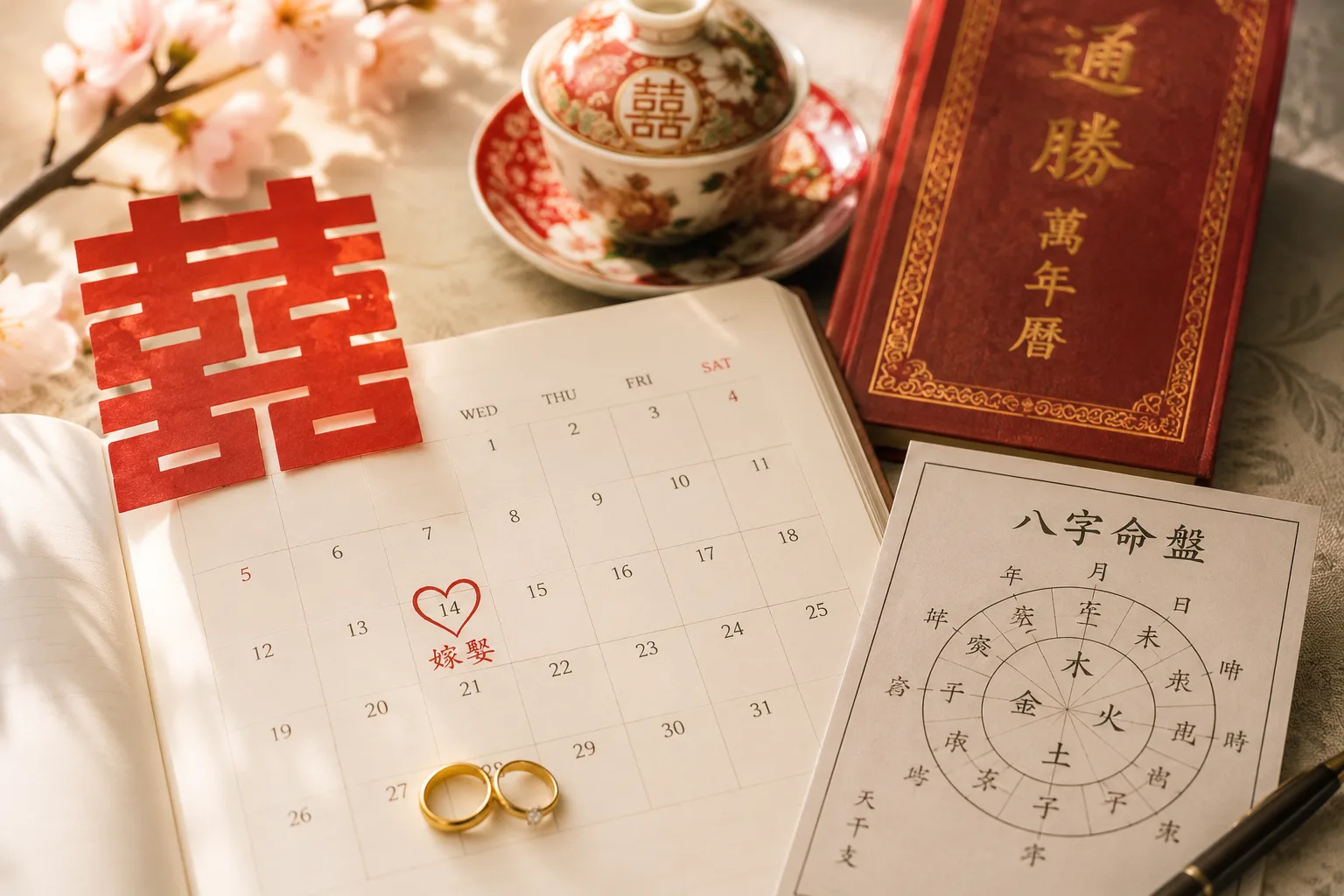
One of the most common questions around a Chinese wedding is surprisingly simple:
Which date is good?
Families may consult the Chinese almanac. Parents may ask a Feng Shui practitioner. Couples compare weekends, hotel availability and the schedules of relatives.
Eventually, someone produces a list of “auspicious dates”.
But this raises a more interesting question:
What actually makes a date auspicious?
And perhaps more importantly:
Auspicious for whom?
There Is No Universally Lucky Date
A date can be generally suitable for marriage and still not be the best date for a particular couple.
This is an important distinction.
Traditional date selection, or 择日, is not simply the search for days labelled 宜嫁娶 — “suitable for marriage”.
That is only the first layer.
A proper selection considers the relationship between the time, the people, and the event itself.
In Lifegate terms, this is a question of 天、地、人.
天 — Timing
What is happening in the calendar at that moment?
地 — Environment
Where and under what practical circumstances
will the event take place?
人 — People
Who is getting married, and how does the chosen
timing interact with them?
The objective is not to discover a magical day.
It is to find a moment where unnecessary conflicts are reduced and the important factors are reasonably aligned.
The Almanac Is a Filter, Not the Answer
Many people begin date selection with the 通胜 / 黄历, the traditional Chinese almanac.
There is nothing wrong with this.
The almanac can tell us whether a particular day is traditionally considered suitable for activities such as marriage, moving house, renovation or opening a business.
But think of this as a general weather forecast.
If the forecast says tomorrow is a good day for running, that does not automatically mean it is the best day for you to run a marathon.
Your condition still matters.
The route matters.
Your preparation matters.
The same principle applies to date selection.
A date marked 宜嫁娶 tells us something about the general quality and traditional classification of the day.
It does not complete the analysis.
The Couple Must Be Part of the Equation
This is where personal birth information becomes relevant.
In traditional Chinese metaphysics, time is expressed through a system of Heavenly Stems and Earthly Branches — 天干地支.
A person’s BaZi chart is built using the same language.
This means the date of an event and the people participating in that event can be compared within one system.
A practitioner may therefore examine whether a proposed wedding date creates significant 冲、刑、害、破 or other undesirable relationships with the couple’s charts, while also looking for supportive relationships where appropriate.
This is why asking:
“What are the lucky wedding dates in 2027?”
is not quite the right question.
A better question is:
“What are the suitable wedding dates for this couple in 2027?”
That small change in language reveals the real purpose of 择日.
What About the Parents?
Traditional wedding date selection often considers the parents as well.
This sometimes surprises modern couples.
But Chinese marriage has historically been understood not simply as the union of two individuals, but as the joining of two families.
There are therefore different schools and traditions regarding whose birth information should be considered and how much weight each person should receive.
For a modern consultation, however, hierarchy matters.
The bride and groom are the principal people involved.
Their relationship with the date should carry greater weight than trying to find a theoretically perfect date for every member of both families.
Once enough people are included, finding a date with absolutely no conflicting relationships can become practically impossible.
Date selection is therefore an exercise in prioritisation, not perfection.
A Good Date That Nobody Can Attend Is Not a Good Wedding Date
This is where modern date selection needs some common sense.
Suppose a practitioner finds a theoretically excellent date.
But it falls on a Tuesday.
The couple cannot take leave.
The grandparents cannot attend comfortably.
The venue they love is unavailable.
Their closest friends are overseas.
And holding the wedding that day would cost substantially more.
Should they still choose it because the metaphysics says it is auspicious?
No.
Because we have forgotten 地 and 人 while pursuing 天.
Chinese metaphysics should help us navigate reality, not escape from it.
A wedding exists in the real world.
Hotel availability matters.
Family schedules matter.
Budget matters.
Travel matters.
The emotional state of the couple matters.
A useful date-selection process therefore works within practical constraints rather than pretending those constraints do not exist.
Selection Is Often More About Removing Problems
There is another misconception about auspicious dates.
People sometimes imagine that a sufficiently powerful date can somehow guarantee a successful marriage.
It cannot.
择日 cannot compensate for incompatibility, poor communication, financial stress or bad decisions.
The date does not live the marriage.
The couple does.
What date selection can attempt to do is much more modest.
It removes obvious conflicts.
It avoids unnecessarily unfavourable timing.
It identifies better windows among the choices already available.
And where possible, it chooses a moment that supports what the couple is trying to begin.
This is less dramatic than saying:
“This date will bring you good fortune.”
But it is also more useful.
吉日 Is Not a Promise
This leads to an important distinction between 吉 and “guaranteed good outcomes”.
An auspicious date should not be understood as a cosmic insurance policy.
It is better understood as favourable conditions.
Consider agriculture.
A farmer can choose the right season to plant.
He can prepare the soil.
He can choose healthy seeds.
He can study the weather.
All of these decisions improve the conditions for growth.
None of them guarantees the harvest.
That does not make timing meaningless.
It simply puts timing in its proper place.
The same applies to a wedding.
择日 concerns the conditions surrounding a beginning.
What happens after that beginning belongs increasingly to 人 — the actions, decisions and character of the people involved.
天时 Matters. But It Is Not Everything.
This is how Lifegate understands the role of wedding date selection.
天 asks:
When is the better moment?
地 asks:
Under what circumstances will this marriage begin?
人 asks:
Who are the people entering it, and what will they do with that beginning?
When these factors work together, we create better conditions for 运 — momentum.
That is the useful idea behind choosing an auspicious wedding date.
Not that one Saturday contains good luck while another contains bad luck.
Not that getting married at a particular hour guarantees wealth, children or lifelong happiness.
But that beginnings matter.
Timing matters.
And when we have the ability to choose our timing, it makes sense to choose thoughtfully.
择日 is not about finding a perfect day.
It is about choosing a better moment to begin.